Who Does What in the Texas Property Tax System
Understand who does what in the Texas property tax system: County Appraisal Districts value property, ARBs hear protests, and taxing units set rates.

Ever wonder who actually decides what your home is worth—and who decides how much you pay? They're not the same people. CAD, ARB, taxing units—if you've ever looked at a property tax document and felt lost in acronyms, you're not alone.
The Texas property tax system involves three main types of entities, each with a distinct role:
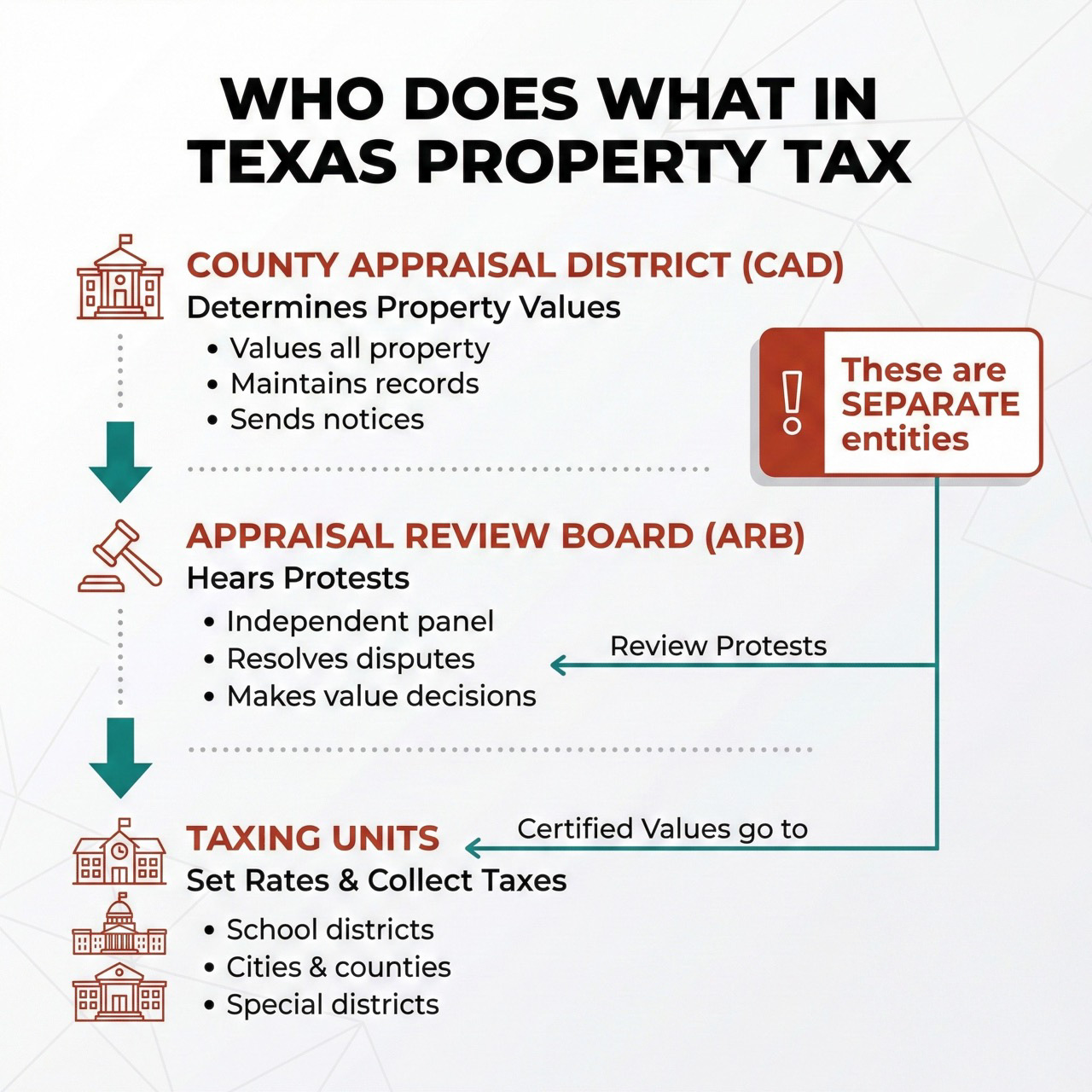
- County Appraisal Districts (CADs) determine property values
- Appraisal Review Boards (ARBs) hear protests and resolve disputes
- Taxing Units set tax rates and collect taxes
These entities are separate from each other. The CAD doesn't set tax rates. The ARB doesn't collect taxes. Understanding these distinctions helps you know who to contact—and what you can and can't challenge.
County Appraisal District (CAD) — They Determine Your Value
The County Appraisal District (CAD) is responsible for determining the value of all taxable property within a county. Each county has one appraisal district (though some use different names—like "Central Appraisal District").
What the CAD Does
- Values property: Uses mass appraisal methods to estimate market value of every property as of January 1 each year
- Maintains property records: Keeps records of property characteristics (square footage, lot size, features, etc.)
- Processes exemptions: Receives and approves applications for homestead exemptions, over-65 exemptions, and others
- Sends notices: Mails the Notice of Appraised Value to property owners
- Defends values: Presents evidence in protest hearings
What the CAD Does NOT Do
- Set tax rates (that's taxing units)
- Collect property taxes (that's the tax assessor-collector)
- Decide protest outcomes (that's the ARB)
Major Texas CADs
| Metro | CAD Name |
|---|---|
| Houston | Harris County Appraisal District (HCAD) |
| Dallas | Dallas Central Appraisal District (DCAD) |
| Fort Worth | Tarrant Appraisal District (TAD) |
| San Antonio | Bexar Appraisal District (BCAD) |
| Austin | Travis Central Appraisal District (TCAD) |
You can look up your property's value on your county CAD's website.
When to Contact the CAD
- Questions about your property's value
- Errors in property records (wrong square footage, etc.)
- Exemption applications and questions
- Questions about your Notice of Appraised Value
Appraisal Review Board (ARB) — They Hear Protests
The Appraisal Review Board (ARB) is an independent panel of citizens that resolves disputes between property owners and the appraisal district.
What the ARB Does
- Hears protests: Property owners (or their representatives) present evidence challenging the CAD's value; the CAD presents its evidence
- Makes decisions: The ARB panel decides whether to uphold the CAD's value, reduce it, or approve a settlement
- Maintains independence: ARB members cannot be employees of the appraisal district, taxing units, or the Comptroller's office
Key Points About the ARB
- ARB members are local citizens appointed to serve
- They must complete state-required training
- They cannot communicate with CAD staff about pending cases outside of hearings
- Their decisions are binding only for the tax year in question
- Property owners can appeal ARB decisions to district court or binding arbitration (a faster, less formal alternative to court)
The ARB is independent from the CAD. Even though ARB hearings take place at the appraisal district offices and involve CAD staff presenting evidence, the ARB itself is a separate entity. This separation is required by law to ensure fairness.
Property owners can appear at ARB hearings themselves or send an authorized representative—such as a professional property tax service—to present their case.
When to Contact the ARB
- Questions about hearing scheduling
- Questions about ARB procedures
- After a hearing, for questions about the decision
Taxing Units — They Set Rates and Collect Taxes
Taxing units are the local governments that actually levy and collect property taxes. Each taxing unit sets its own tax rate based on its budget needs.
Types of Taxing Units
- School districts — Fund public education (typically the largest portion of your bill)
- Counties — Fund county government services
- Cities/municipalities — Fund city services (only if you live within city limits)
- Special districts — Hospital districts, water districts, community colleges, emergency services districts, MUDs, etc.
What Taxing Units Do
- Set tax rates: Each unit determines its own rate through an annual budget process
- Adopt budgets: Budgets determine how much revenue is needed, which informs the tax rate
- Collect taxes: The county tax assessor-collector collects taxes on behalf of all taxing units, then distributes the revenue
How Rates Are Set
Taxing units follow a specific process each year:
- 1Calculate budget needs for the coming year
- 2Determine the tax rate needed to generate that revenue
- 3Hold public hearings on the proposed rate
- 4Adopt the final rate (typically in August–September)
Important: You cannot protest tax rates through the appraisal district or ARB. Tax rates are set through a separate political process involving elected officials and public hearings. What you CAN protest is your property's appraised value.
For more on what can and cannot be protested, see Tax Rate vs. Property Value: What Can Be Protested.
When to Contact Taxing Units
- Questions about tax rates
- Questions about what services your taxes fund
- Attending public hearings on proposed tax rates
How They Work Together (But Stay Separate)
The annual cycle works like this:
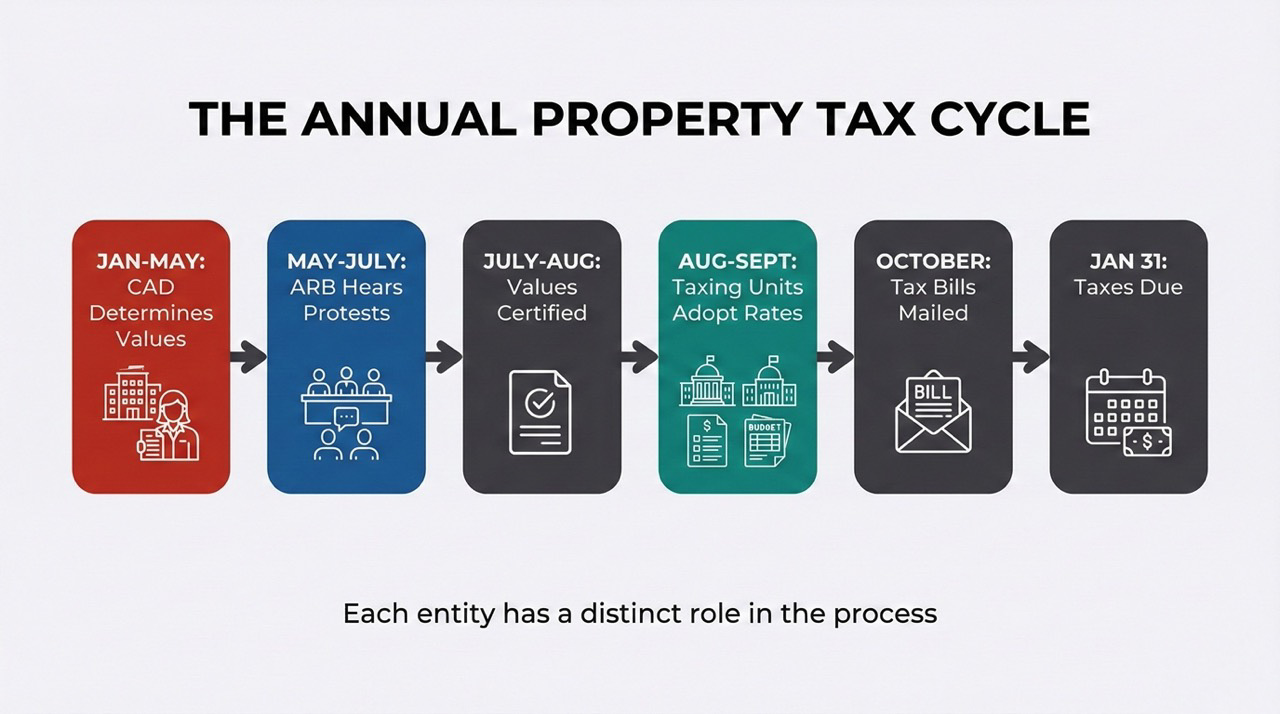
- CAD determines values (January – May)
- ARB hears protests (May – July)
- Values are certified
- Taxing units adopt rates (August – September)
- Tax bills calculated and mailed (October)
- Tax assessor-collector collects payment (Due January 31)
Yes, it involves multiple entities—but once you see how they connect, it makes sense.
The Separation Matters
- If you think your value is wrong → Work with the CAD/ARB
- If you think the tax rate is too high → Attend taxing unit budget hearings, vote in local elections
- If you have questions about your bill or payment → Contact the tax assessor-collector
Understanding this separation helps you direct questions to the right place—and understand what you can and cannot challenge through the protest process.
Key Takeaways
- CAD (County Appraisal District) determines your property's value
- ARB (Appraisal Review Board) hears protests and makes decisions—they're independent from the CAD
- Taxing units (schools, county, city, special districts) set tax rates and collect taxes
- You can protest your VALUE through the CAD/ARB process
- Tax rates? You can't protest those. They're set by elected officials—vote if you want to influence them.
What's Next?
Now that you understand who does what, learn about your options for challenging your property's value. See What Is a Property Tax Protest? for next steps.