Your Guide to Property Tax Terms
Definitions of key Texas property tax terms: appraisal, ARB, CAD, homestead exemption, protest, taxable value, and more. Your complete reference guide.

Property tax documents are full of terms and acronyms that can be confusing. This glossary provides plain-language definitions of the most common terms you'll encounter when dealing with Texas property taxes.
Use this page as a reference when reading your Notice of Appraised Value, tax bill, or other property tax documents. Terms are organized alphabetically, with links to detailed articles where available.
A
Ad Valorem Tax
A tax based on the value of property. Texas property taxes are ad valorem taxes—the amount you owe is determined by your property's value.
Appraised Value
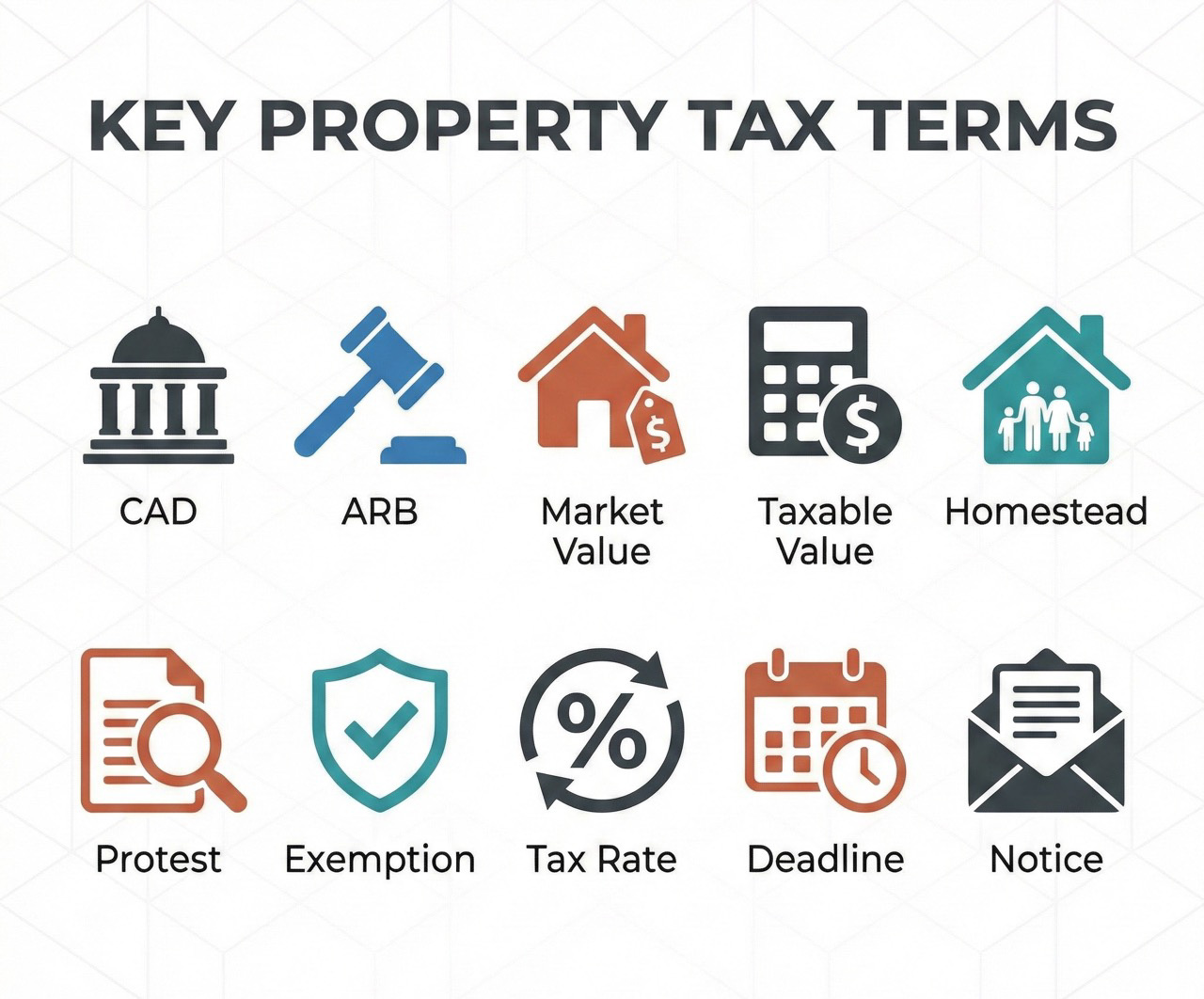
The County Appraisal District's estimate of your property's market value as of January 1. This is the starting point for calculating your property taxes. See: Market Value vs. Assessed Value vs. Taxable Value
Appraisal District
See: County Appraisal District (CAD)
Appraisal Review Board (ARB)
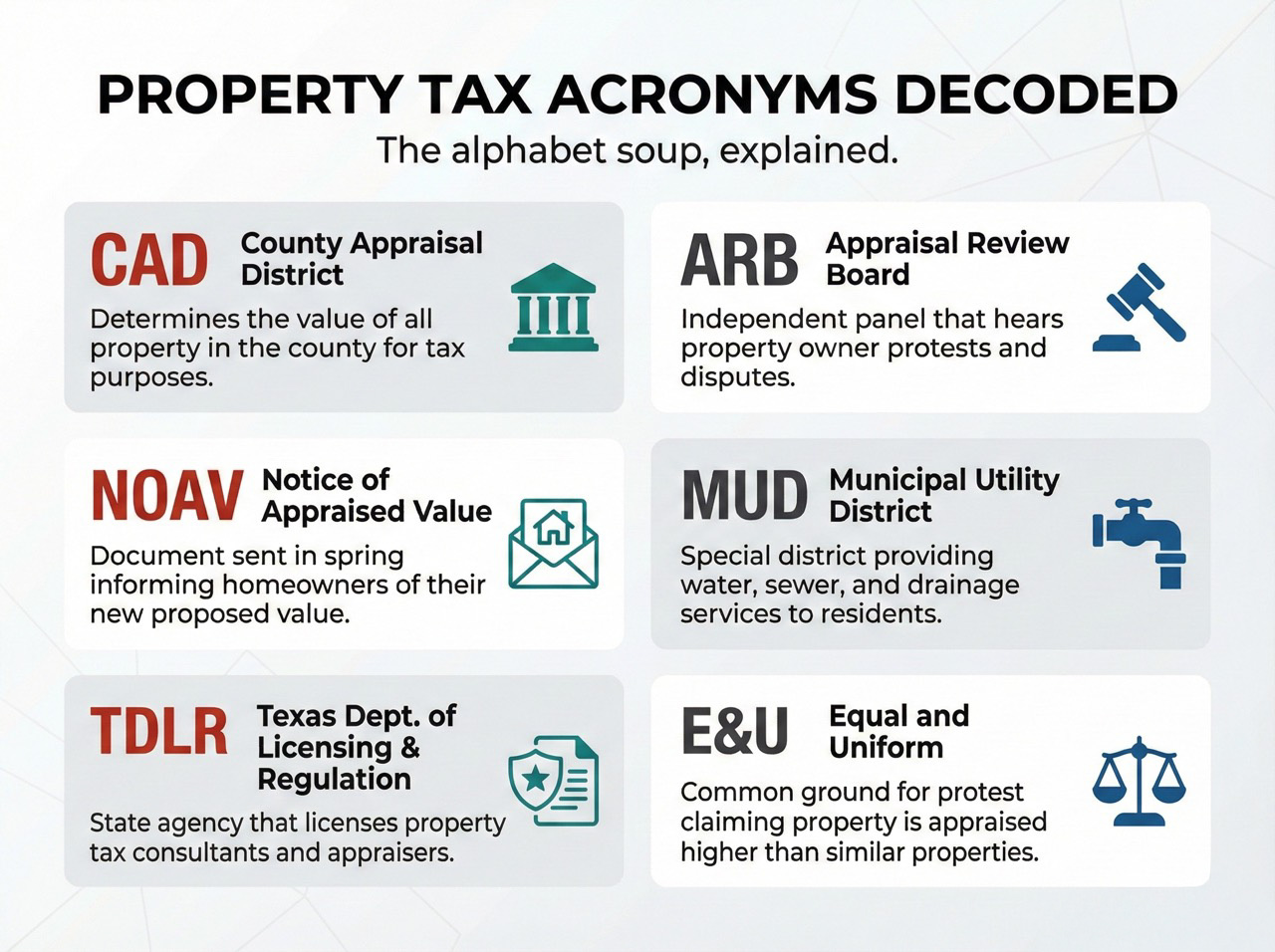
An independent panel of local citizens that hears property tax protests and makes decisions on value disputes between property owners and the appraisal district. The ARB is separate from the appraisal district. See: Roles of the CAD, ARB, and Taxing Units
Appraisal Roll
The official list of all properties in a county along with their appraised values. The appraisal district certifies the roll after protests are resolved.
Assessed Value
For homesteaded properties, this is your market value limited by the 10% homestead cap. For non-homesteaded properties, assessed value equals market value. Assessed value minus exemptions equals taxable value. See: Market Value vs. Assessed Value vs. Taxable Value
Assessment Ratio
In Texas, the assessment ratio is 100%—meaning property is assessed at full market value. Some states assess at a percentage of market value, but Texas does not.
B–C
Binding Arbitration
An alternative to judicial appeal for challenging an ARB decision. Available for certain properties under $5 million. A neutral arbitrator makes a final, binding decision.
CAD
See: County Appraisal District
Certified Value
The final appraised value after all protests are resolved and the appraisal roll is certified. This is the value used to calculate your tax bill.
Comparable Sales (Comps)
Recently sold properties similar to yours that are used to estimate market value. The appraisal district uses comps to value your property, and comps can be used as evidence in a protest.
County Appraisal District (CAD)
The local government agency responsible for determining the value of all taxable property in a county. Each Texas county has one CAD (examples: HCAD in Harris County, DCAD in Dallas County, TCAD in Travis County). See: Roles of the CAD, ARB, and Taxing Units
D–E
Delinquent Taxes
Property taxes that remain unpaid after the January 31 deadline. Delinquent taxes accrue penalties and interest starting February 1. See: Property Tax Payment Deadlines
Equal and Uniform (E&U)
A constitutional requirement that properties be appraised equally compared to similar properties. "Unequal appraisal" is a valid ground for protest—you can argue your property is valued higher than comparable properties in the district's records.
Exemption
A reduction in taxable value granted to qualifying property owners. Common exemptions include homestead, over-65, disability, and veteran exemptions. Exemptions reduce the amount of taxes you owe.
F–H
Homestead
Your primary residence. Must be owned and occupied as your principal residence to qualify for homestead exemptions.
Homestead Cap (10% Cap)
A limit on how much a homesteaded property's assessed value can increase each year—no more than 10% above the prior year's assessed value (plus the value of new improvements). Does not limit market value. See: Market Value vs. Assessed Value vs. Taxable Value
Homestead Exemption
A tax exemption for your primary residence. As of 2026, provides a $140,000 reduction in taxable value for school district taxes, plus additional amounts for over-65 or disabled homeowners.
I–M
Informal Hearing
A meeting between a property owner (or their representative) and an appraiser to discuss the property's value before a formal ARB hearing. Many protests settle at this stage.
Judicial Appeal
A lawsuit filed in district court to challenge an ARB decision. Must be filed within 60 days of the ARB order.
Market Value
The price your property would sell for in the open market as of January 1. This is what the appraisal district estimates when valuing your property. Market value can increase or decrease any amount from year to year. See: Market Value vs. Assessed Value vs. Taxable Value
Mass Appraisal
The method appraisal districts use to value many properties at once using statistical analysis and modeling, rather than individual appraisals. Necessary because districts must value hundreds of thousands of properties.
MUD (Municipal Utility District)
A type of special district that provides water, sewage, drainage, and other services, particularly common in newer developments. MUDs are taxing units that appear as separate line items on your tax bill.
N–P
Notice of Appraised Value (NOAV)
The official document sent by the appraisal district in spring showing your property's appraised value. This notice triggers your protest deadline. Not the same as your tax bill. See: Notice of Appraised Value Explained
Over-65 Exemption
Additional exemption available to homeowners age 65 or older. Provides a $60,000 additional exemption (total $200,000 for school taxes when combined with general homestead) plus a tax ceiling (freeze) on school district taxes.
Penalty
A charge added to delinquent property taxes. Starts at 6% on February 1 and increases monthly. See: Property Tax Payment Deadlines
Protest
A formal challenge to your property's appraised value filed with the appraisal district. If successful, results in a lower value and lower taxes. See: What Is a Property Tax Protest?
Protest Deadline
The last day to file a protest—typically May 15 or 30 days after the Notice of Appraised Value is mailed, whichever is later.
R–T
Rendition
A report filed by business owners listing their taxable personal property (inventory, equipment, etc.). Not typically required for residential homeowners.
Tax Assessor-Collector
The county official responsible for collecting property taxes on behalf of all taxing units in the county. Not the same as the appraisal district.
Tax Bill (Property Tax Statement)
The invoice you receive in October showing how much property tax you owe. Due January 31. Different from the Notice of Appraised Value. See: Understanding Your Property Tax Bill
Tax Ceiling (Tax Freeze)
A limit on school district taxes for over-65 or disabled homeowners. Once the ceiling is set, school taxes cannot increase unless you make improvements or lose the exemption.
Tax Rate
The amount charged per $100 of taxable value by each taxing unit. Multiple rates from different taxing units are added together to determine your total rate.
Taxable Value
Your assessed value minus exemptions. This is the value that gets multiplied by tax rates to calculate your taxes. See: Market Value vs. Assessed Value vs. Taxable Value
Taxing Unit
A local government that levies property taxes: school districts, counties, cities, and special districts (hospital, water, community college, etc.). See: Roles of the CAD, ARB, and Taxing Units
TDLR
Texas Department of Licensing and Regulation. The state agency that licenses property tax consultants.
U–Z
Unequal Appraisal
A basis for protest arguing that your property is appraised higher than similar properties. Also called "equal and uniform" or "E&U" protest ground.
Value
See: Market Value, Assessed Value, Taxable Value